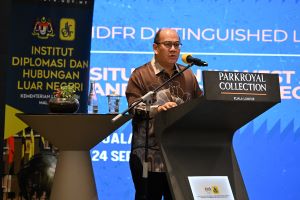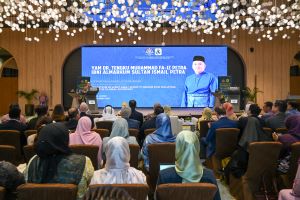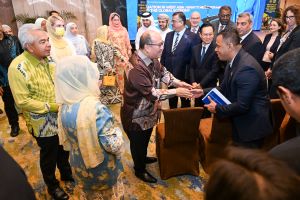
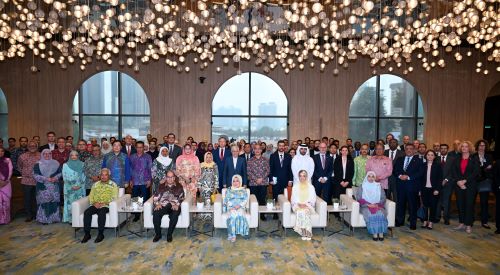
On 24 September 2026, IDFR organised the IDFR Distinguished Lecture Series entitled ‘Situation in West Asia: What it Means for Malaysia and the Global Economy’ in Kuala Lumpur’. The lecture was delivered by YAM Dr Tengku Muhammad Fa-Iz Petra ibni Almarhum Sultan Ismail Petra. The programme was graced by the presence of YMM Tengku Anis binti Almarhum Tengku Abdul Hamid, Raja Perempuan of Kelantan. YBhg. Tan Sri Amran Mohamed Zin, Secretary General of the Ministry of Foreign Affairs, Malaysia, delivered the Welcome Remarks at the event.
In his Distinguished Lecture, YAM Dr Tengku Muhammad Fa-Iz Petra ibni Almarhum Sultan Ismail Petra examined the economic implications of developments in West Asia at the global and regional levels, as well as domestically. He highlighted how disruptions to key shipping routes, particularly through the Strait of Hormuz, could affect energy supplies, international trade and global supply chains, contributing to higher inflation, increased production costs and pressures on global growth. He also noted that the impact vary across countries, depending on their energy structures and reliance on imported fuels, while underscoring the close link between energy security and the transition towards renewable energy. For Malaysia, developments in West Asia have highlighted the country’s exposure to external energy shocks, rising fuel costs and increased fiscal pressures arising from subsidies, as well as structural challenges associated with the heavy reliance on petrol-powered private vehicles.
The lecture noted that while alternatives such as electric vehicles, biodiesel, natural gas and renewable energy could contribute to greater resilience, their wider adoption faces various infrastructure, cost and implementation challenges. In the longer term, strengthening renewable energy capacity and developing more comprehensive rail and public transport networks were highlighted as potential measures to reduce dependence on imported oil, enhance energy resilience and ease the fiscal burden of fuel subsidies.
The lecture provided valuable insights into the broader economic and strategic implications of the evolving situation in West Asia, particularly its potential effects on energy security, trade and economic resilience. The programme was attended by members of the diplomatic corps, officials from ministries and government agencies, think tanks, and academics.