




Journal of Diplomacy and Foreign Relations
THE JOURNAL OF DIPLOMACY AND FOREIGN RELATIONS - VOLUME 14 NUMBER 1 AUGUST 2014
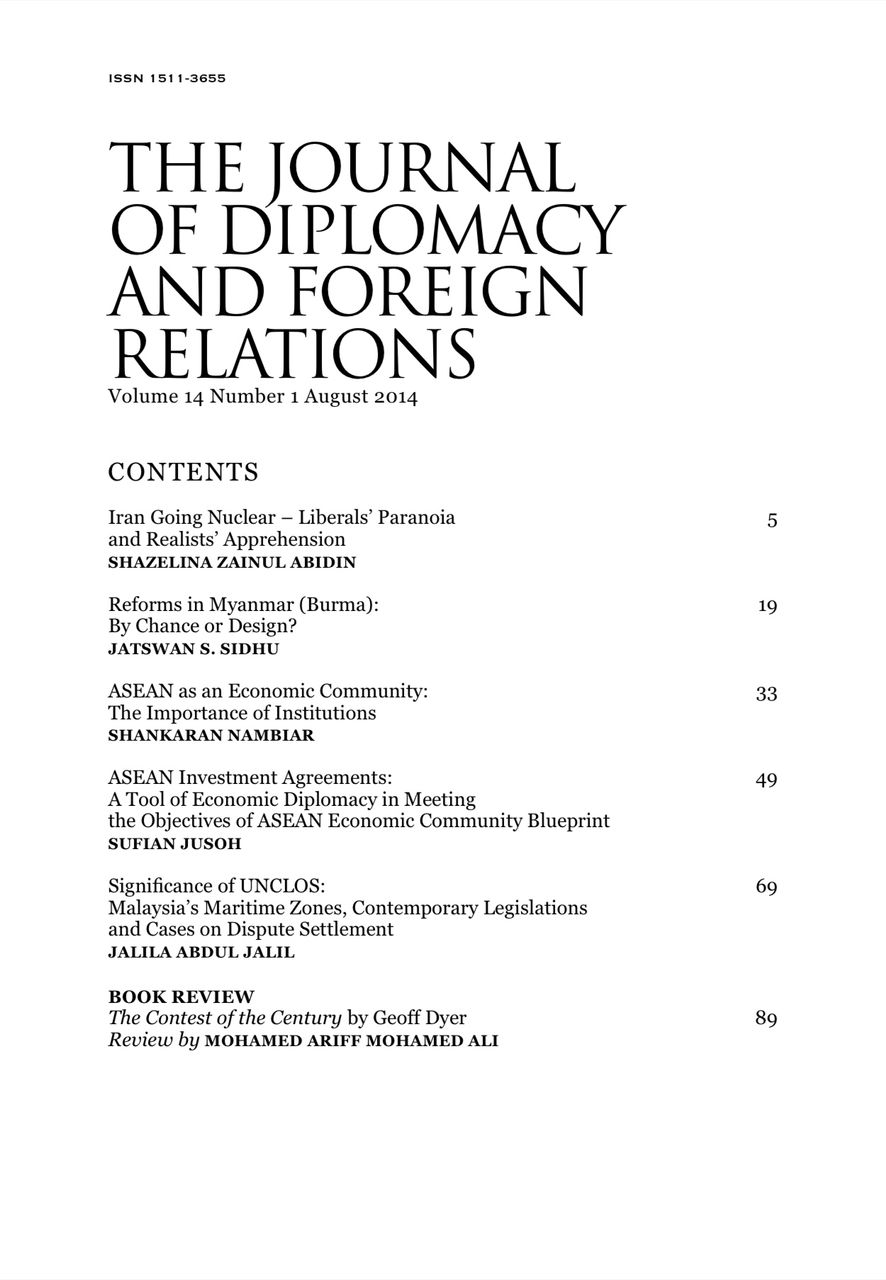
Contents
Iran Going Nuclear – Liberals’ Paranoia and Realists’ Apprehension
Download File Total Downloads 498 time(s)Set against the backdrop of the successful November 2013 negotiations between Iran and the P5+1, this article argues that there is very little basis for liberals’ paranoia in Iran achieving nuclear capability. Using realists’ arguments on the subject, the article then sets out to examine the validity of these many arguments. Among the claims looked at is the fear that Iran might spark a Middle East arms race; that its leaders are irrational and therefore unreliable; and that they might transfer nuclear weapons to violent entities. The change in Iranian leadership in 2013 and a thawing of relations between Iran and the West since then has meant that the paranoia of the past might now give way to a wary apprehension of things that might be.
Reforms in Myanmar (Burma): By Chance or Design?
Download File Total Downloads 321 time(s)The changes that have been ushered by Myanmar’s nominally civilian government since early 2011 have caught the attention of many around the world. While some were fairly surprised at the changes that began unfolding, others however remain sceptical and cautiously optimistic. This is because while elections were held on 7 November 2010, these were however, far from free and fair. In fact, the military that usurped power in 1962 remain at the helm but one that is now disguised as pseudo-civilian government. In line with the reforms that began unfolding since early 2011, this article argues that all these changes that have been undertaken are a product of almost two decades of careful strategic planning by the country’s military junta, mainly aimed at perpetuating its hold on state power. A careful analysis of events since 1988 proves that these reforms were by no means impromptu but rather one that had been carefully planned and designed.
ASEAN as an Economic Community: The Importance of Institutions
Download File Total Downloads 216 time(s)ASEAN has been progressing from the creation of the ASEAN Free Trade Area (AFTA), towards a more comprehensive view of the region. At the ASEAN Summit in Phnom Penh in 2002, it was proposed that the ASEAN Economic Community (AEC) be established, with the intention of creating an economic community by 2015. AEC seeks to develop regional economic integration, economic cooperation and fostering a community that values regional security and political stability. These are ambitious goals, none of which are possible without a solid institutional base. However, the notion of an institutional structure has been limited hitherto to that of establishing appropriate organisations for the functioning of a regional community. More foundational than organisations are the norms and conventions that guide economic behaviour since institutions conceived in this manner are the route to a sense of community among a disparate collection of member states.
ASEAN Investment Agreements: A Tool of Economic Diplomacy in Meeting the Objectives of ASEAN Economic Community Blueprint
Download File Total Downloads 405 time(s)ASEAN as a region is an attractive investment destination that has continuously received high level of foreign direct investment. ASEAN intends to achieve the ASEAN Economic Community status by the end of 2015 which is important milestone for the region. To continue becoming an attractive region, ASEAN is an avid practitioner of economic diplomacy. The practice of economic diplomacy through several investment agreements will assist ASEAN in achieving its objective of becoming a single investment destination. ASEAN, which is without political and military might, may also use the investment agreements to fend off aggressive foreign policies from more powerful regional neighbours. To achieve the objectives set by the Member States, ASEAN will also need to encourage intra-ASEAN economic diplomacy practice, where the more developed ASEAN Member States will be able to contribute to the economic prosperity of the lesser developed Member States.
Significance of UNCLOS: Malaysia’s Maritime Zones, Contemporary Legislations and Cases on Dispute Settlement
Download File Total Downloads 1252 time(s)Maritime issues have always been important to Malaysia as shown by her active participation in UNCLOS I, UNCLOS II and UNCLOS III since independence in 1957. The importance of establishing Malaysia’s respective maritime zones is reflected in the promulgation of legislation on the continental shelf in 1966 and the territorial seas in 1969 which resulted in Notification No. 5745 of 21 December 1979 establishing a new map of the continental shelf of Malaysia. The 1979 Map, produced in large scale in two sheets, shows the territorial sea and continental shelf covering both Peninsular Malaysia, and Sabah and Sarawak. It shows Malaysia’s maritime boundaries based on treaties, unilateral declarations, and a single maritime boundary line covering all its maritime sectors. The publication of the 1979 Map engendered much interest and protests especially from neighbouring states. Two disputes arising from the publication of the Map were resolved at the ICJ reflecting Malaysia’s commitment in resolving disputes through peaceful means.


