




Journal of Diplomacy and Foreign Relations
THE JOURNAL OF DIPLOMACY AND FOREIGN RELATIONS - VOLUME 14 NUMBER 2 DECEMBER 2014
Contents
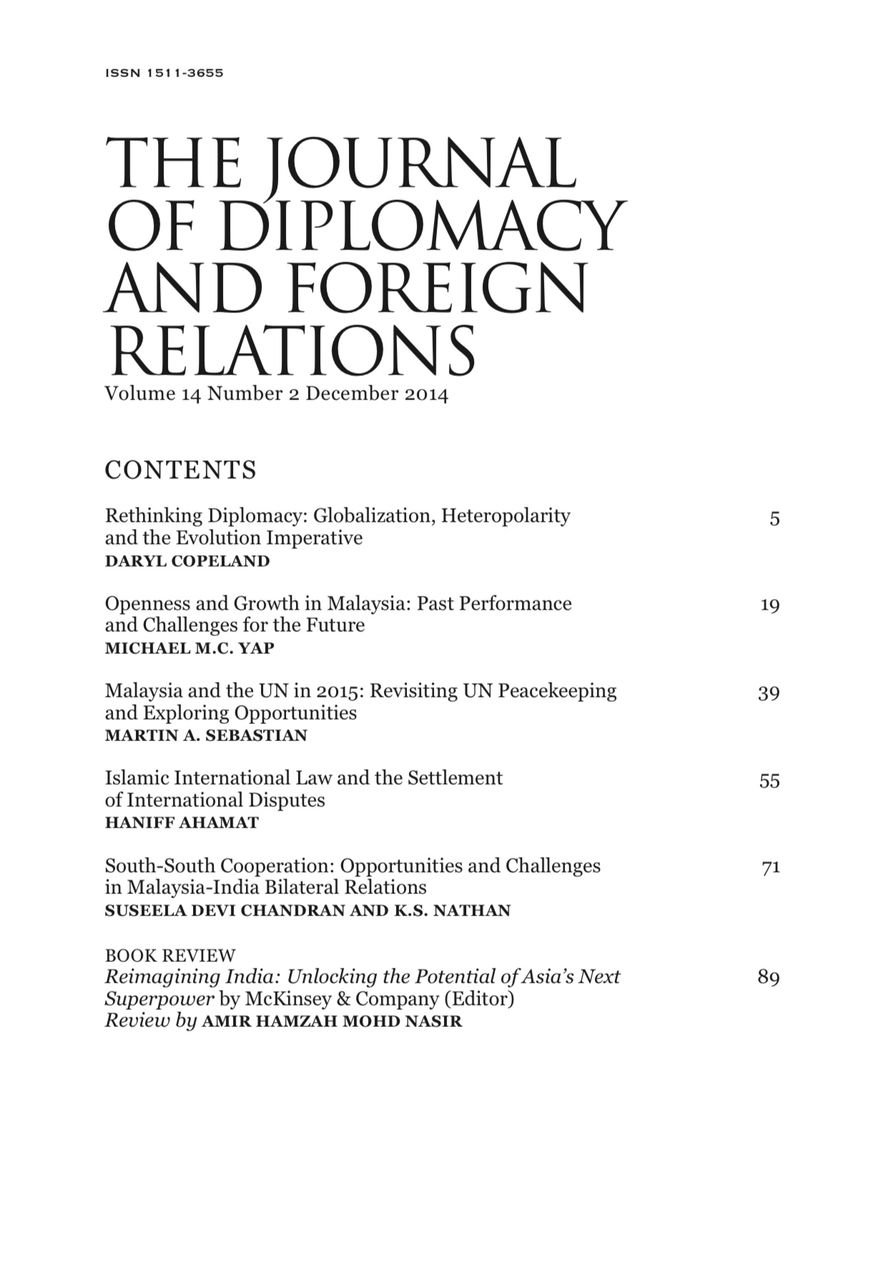
Rethinking Diplomacy: Globalization, Heteropolarity and the Evolution Imperative
Download File Total Downloads 235 time(s)The defining historical process of our times, globalization, is relentlessly conditioning, if not determining outcomes across vast tracts of human activity. In part as a result, a heteropolar world is emerging, one in which the sources of power and influence are based more on difference than on similarity. Diplomacy is struggling to evolve in the face of these transformative forces. Yet, none of the key elements of the diplomatic ecosystem – the foreign ministry, the foreign service or the diplomatic business model – are adapting well or quickly enough. Radical reform will be required if diplomacy is to achieve its potential as a non-violent approach to the management of international relations and global issues through dialogue, negation and compromise.
Openness and Growth in Malaysia: Past Performance and Challenges for the Future
Download File Total Downloads 372 time(s)The Malaysian economy has shown impressive growth since the 1970s, benefitting from an outward-oriented development strategy. As one of the East Asian “miracle” economies, its growth was driven by exports of manufactured goods, especially in electrical and electronics products. The country has also been a major attraction for foreign direct investment in the Southeast Asia region, using incentives to woo foreign investors and offering trainable low-wage labour, good infrastructure and political stability. However, after years of robust economic growth, its comparative advantage is changing. Other low-wage labour countries like China are a threat to Malaysia’s competitiveness in export markets. The country has adopted the New Economic Model (NEM) to drive future growth by upgrading the economy to knowledge and technology-intensive high-income activities. However, there are serious obstacles to upgrading such as the shortage of high-skilled labour compounded by a brain drain phenomenon, deteriorating schooling standards and declining tertiary education institutions. The heavy state involvement in the economy also dampens competitiveness, while an affirmative action policy that has long been in place means that meritocracy is not emphasised sufficiently. The much needed changes in the economy are likely to face resistance from some groups. Although knowing what needs to be done, the government will have to show political will to steer the economy forward, while maintaining balance in order to preserve social harmony.
Malaysia and the UN in 2015: Revisiting UN Peacekeeping and Exploring Opportunities
Download File Total Downloads 509 time(s)Since sending UN Peacekeepers to Congo in 1960, many Malaysians have served as civilian observers, military observers, troops and police contingents for UNPKO throughout the world, except for the Americas. Malaysia was once the sixth largest UN Troop Contributing Countries (TCC). Malaysians have served in all types of climates, ranging from the coldest winters in Bosnia to the scorching deserts in Sahara. Malaysia was the first ASEAN member to participate in UNPKO and closer to home, Malaysian “blue helmets” had served in Cambodia and East Timor. Exceptional Malaysians have led UNPKO in field missions like Somalia and Tajikistan. Leaders par excellence have risen to the ranks of Assistant Secretary General (ASG) in UNHQ New York. In 2015, Malaysia is a non-permanent member in the UN Security Council (UNSC). This paper discusses some of the UN approaches in dealing with threats to global peace and security. It then reflects on Malaysia’s experience and inherent capabilities, exploring opportunities for Malaysia to complement UN approaches and remain relevant as a “veteran” in UNPKO.
Islamic International Law and the Settlement of International Disputes
Download File Total Downloads 300 time(s)This article examines the possibility of institutionalising Islamic international law or siyar in international dispute settlement. This article starts by arguing that Islamic international law has developed as a branch of law since the eighth century, but it started to decline following the colonisation of the Muslim States by the West. However, with the emergence of independent Muslim States, the revival of such law is possible, and this also includes its possible use in dispute settlement. This article finds that Article 38 of the ICJ Statute could provide the avenues for Islamic international law rules to be referred to by the relevant international adjudicating bodies but based on case law, the avenues are confined to general principles of law.
South-South Cooperation: Opportunities and Challenges in Malaysia-India Bilateral Relations
Download File Total Downloads 334 time(s)South-South Cooperation (SSC) is a broad framework for collaboration among countries of the South in the political, economic, social, cultural, environmental and technical domains. Involving two or more developing countries, it can take place on a bilateral, regional, sub-regional or international basis. SSC may be defined as a strategy for the greater mutual use of developing countries’ resources to promote economic independence, increased self-reliance and improved bargaining with the developed countries. This article attempts to examine and evaluate the nature and level of Malaysia-India cooperation on South issues.
Firstly, it traces briefly the origins, growth and development of the Malaysia-India bilateral relationship especially in the economic, defence and socio-cultural aspects. Secondly, it examines some of the significant developments that took place including the signing of the bilateral Malaysia-India Comprehensive Economic Cooperative Agreement (MICECA) and the regional ASEAN-India Free Trade Agreement (AIFTA) as manifestations of South-South cooperation. Thirdly, it evaluates the relevance of the Malaysian Technical Cooperation Programme (MTCP) in Malaysia-India relations. Finally, the article concludes by arguing that given the present steady growth record, Malaysia-India cooperation can be a model for the future of South-South cooperation in terms of facing common challenges and seizing strategic opportunities to promote development, security, peace and progress in the current regional and world order.


