




Journal of Diplomacy and Foreign Relations
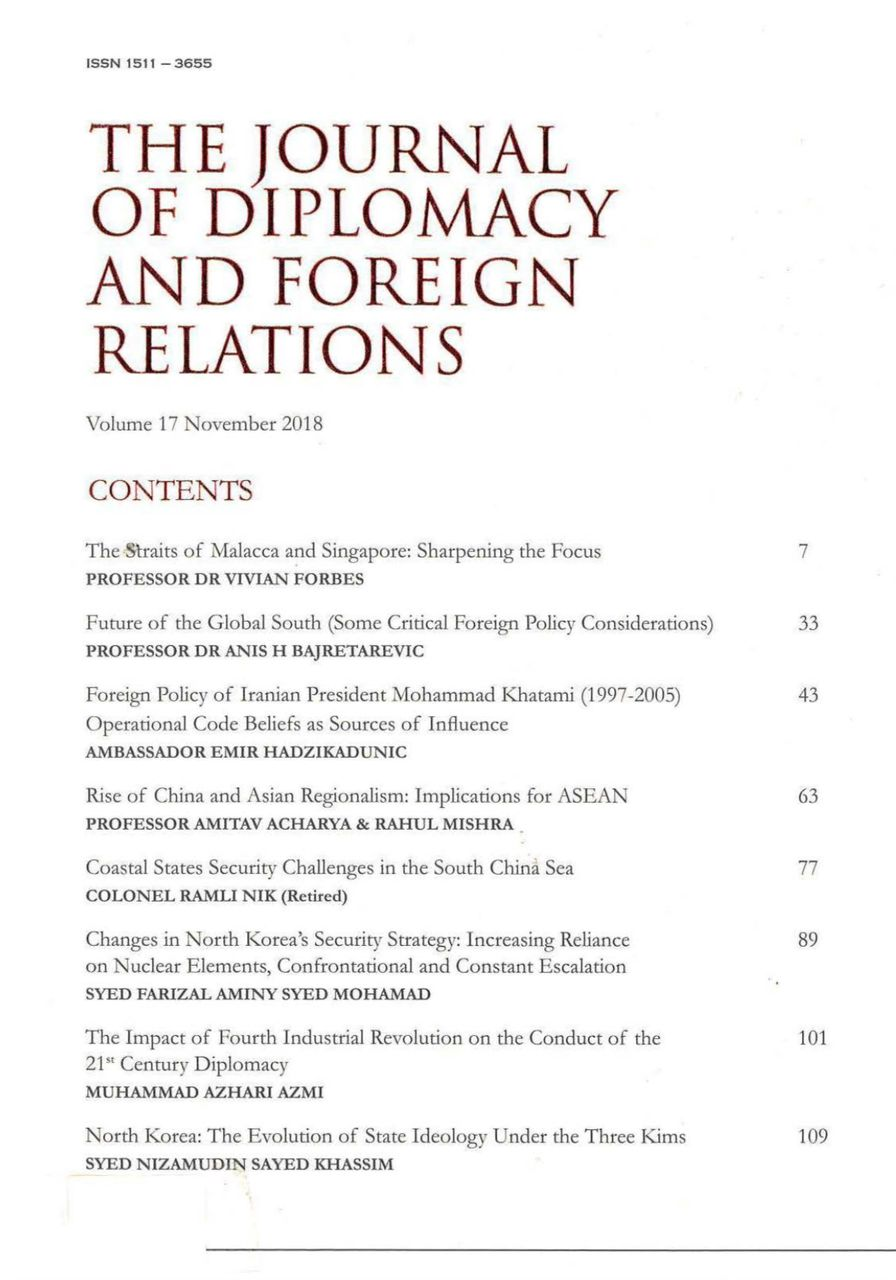
THE JOURNAL OF DIPLOMACY AND FOREIGN RELATIONS - VOLUME 17 NUMBER 1, NOVEMBER 2018
Datuk Mohammad Sadik Kethergany
Ambassador Mohammad Azhar Mazlan
Mr Zakaria Nasir
Major Mohd Ridzuan M Shariff (Retired)
Contents
STRAITS OF MALACCA AND SINGAPORE: SHARPENING THE FOCUS
Download File Total Downloads 1076 time(s)Maritime security, sovereignty issues, well-being at sea and safety to navigation collectively relate to geopolitical issues that require the principles of international law and international relations to be applied in order to resolve the myriad of problems in the regional seas of Southeast Asia. In the context of the Straits of Malacca and Singapore many issues manifest themselves on a daily basis despite the fact that on the surface, no pun intended, there appears to be 'smooth sailings'. The Belt and Road Initiative will bring economic advantages and yet it imposes many challenges. This brief study alludes to the competitive nature demonstrated by the littoral states to attract a larger share of maritime trade; offers an analysis of the issues that confront the States administering the Straits; and, concludes that the focus needs to be sharpened to ensure any problems that are experienced are kept to a minimum
FUTURE OF THE GLOBAL SOUTH (SOME CRITICAL FOREIGN POLICY CONSIDERATIONS)
Download File Total Downloads 203 time(s)FOREIGN POLICY OF IRANIAN PRESIDENT MOHAMMAD KHATAMI (1997-2005) - OPERATIONAL CODE BELIEFS AS SOURCES OF INFLUENCE
Download File Total Downloads 495 time(s)This article explores operational code master beliefs of Mohammad Khatami (1997- 2005) as possible causes for his characteristic foreign policy behavior. In this regard, the quantitative indicators of his beliefs (his subjective representation of reality of world affairs) are taken as appropriate explanatory factors using methodological and theoretical innovations represented by Verbs in Context System (VICS), Theory of Inferences about Preferences (TIP) and Theory of Moves (TOM). First, this study aims to uncover his subjective meanings of the situation in which he finds himself defined as his philosophical beliefs. The study also aims to expose his strategic orientation in world affairs that he finds the most appropriate to achieve his foreign policy goals known as his instrumental beliefs. In this respect, it seeks to address whether his master beliefs as cognitive constrains correspond to his foreign policy. Second, the study expands this scope with a broader framework to discuss his strategic orientation between conflict and cooperation and preference ordering between settlement, deadlock, submission and dominance using relevant theoretical propositions from TIP. It uses an average score of diverse 35 world leaders as the reference group to put his master beliefs into a wider perspective. In the last part, it extends data analysis with theoretical innovations represented by sequential game models in Brams's Theory of Moves. The study examines here his foreign policy outcomes between settlement and deadlock from his subjective games using his strategic preference. The core argument of this study reflects the cognitivist proposition that beliefs of Khatami matter in the explanation of his foreign policy behavior not addressed by other theoretical perspectives from neorealist, constructivist or neoliberal approaches. Without denying possible influence of other causes, the study finds operational code beliefs of Khatarni to have important reflections in assessing his foreign policy preference and outcomes.
RISE OF CHINA AND ASIAN REGIONALISM: IMPLICATIONS FOR ASEAN
Download File Total Downloads 868 time(s)CHANGES IN NORTH KOREA'S SECURITY STRATEGY: INCREASING RELIANCE ON NUCLEAR ELEMENTS, CONFRONTATIONAL AND CONSTANT ESCALATION
Download File Total Downloads 322 time(s)THE IMPACT OF FOURTH INDUSTRIAL REVOLUTION ON THE CONDUCT OF THE 21st CENTURY DIPLOMACY
Download File Total Downloads 241 time(s)This article explores the anticipated impact of the Fourth Industrial Revolution (4IR) in influencing 21st century diplomacy. Based on the characteristics of the 4IR as dissected by Prof. Klaus Schwab, author of the book The Fourth Industrial Revolution, the writer divides his article into three sections: Introduction, Analysis, and Conclusion. As the introductions runs through the previous industrial revolutions and delves into the definition of the 4IR and 21st century diplomacy, the Ana!Jsis section poses three assumptions connecting the 4IR and 21"1 century diplomacy. Based on current trends, as the 4IR envelops the globe, the writer discusses that diplomats are expected to spend more time negotiating matters related to cyberspace; big data will demand foreign ministries (MFAs) to engage more actively in public diplomacy; and nation-states are anticipated to broaden its engagement with non-state actors. In the Conclusion section, highlighting a few instances of governments' efforts in embracing the 4IR, the writer reiterates that the practitioners of 21st century diplomacy must centre their focus on working closely with different stakeholders in order to ensure that the 4IR will only bring overwhelming benefit to mankind
NORTH KOREA: THE EVOLUTION OF STATE IDEOLOGY UNDER THE THREE KIMS
Download File Total Downloads 1858 time(s)State ideologies, though presented as the collective will of the people, do not always represent the ethos or wishes of its citizens. In most circumstances, state ideologies are political tools for governments to gain power or retain their control over the society (Althusser, 1970). This is highly apparent in North Korea, where state ideologies are utilised by the three (3) successive Kims to gain, legitimise and secure their power in the Hermit Kingdom (Kim Hyung-Kook, 2011). The aim of this paper is to examine how Kim II Sung, Kim Jong II and Kim Jong Un brought North Korea's state ideology into various stages of evolution to serve their respective political needs. The scope of this paper spans from the beginning of Kim II Sung's rule to the latest successor of the Kim dynasty, Kim Jong Un. This paper will be divided into four (4) main parts. The Introduction will provide a definition of state ideology and how it is merged into the ideological state apparatuses. This is followed by the analysis on North Korea's home-grown ideologies and its overall ideological framework. The third part will follow the development of the state ideology chronologically from the era of Kim II Sung to the age of Kim Jong Un. The paper concludes that the Kim dynasty will constantly reshape the state ideology of North Korea to reflect the current challenges and setbacks to sustain their grip on North Korea


