




Journal of Diplomacy and Foreign Relations
THE JOURNAL OF DIPLOMACY AND FOREIGN RELATIONS - VOLUME 18 NUMBER 1, NOVEMBER 2019
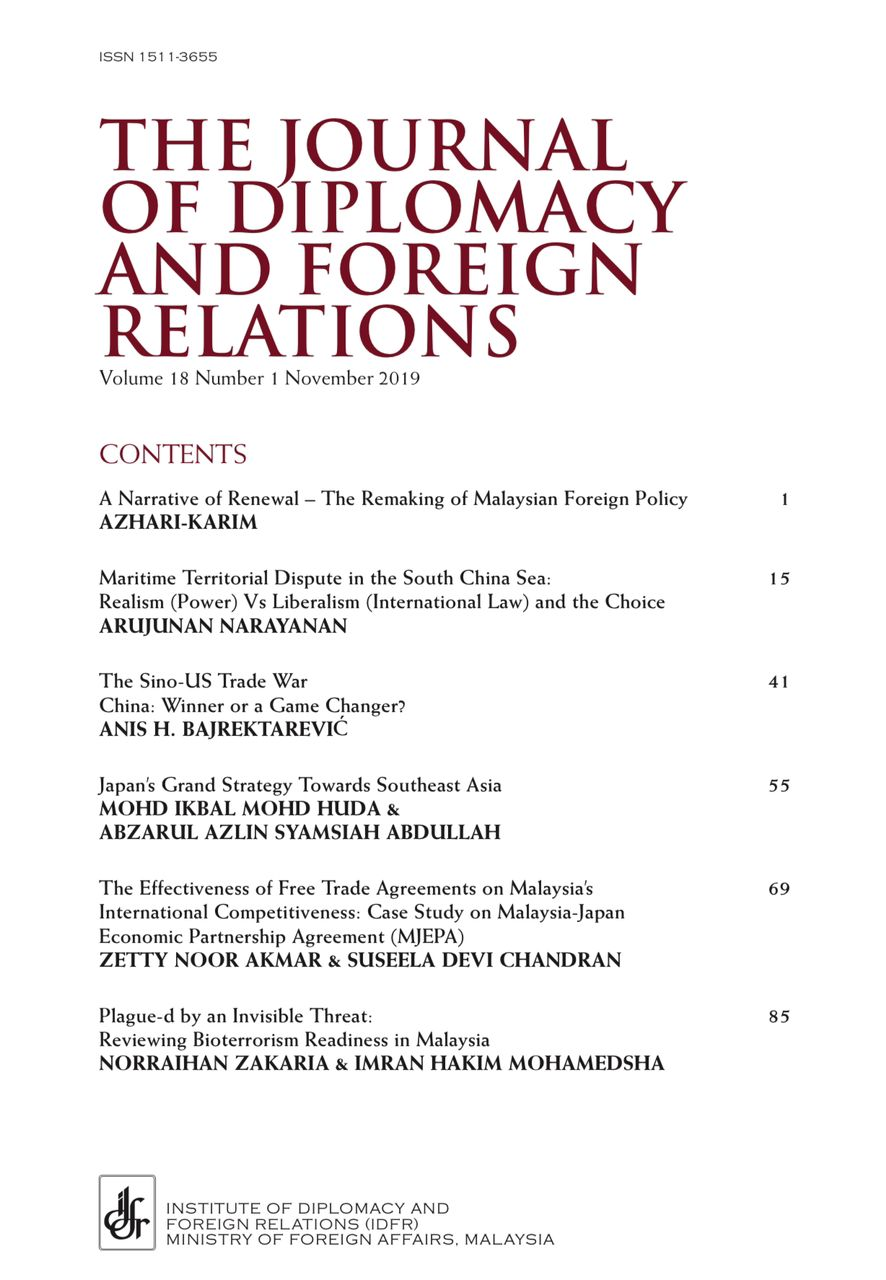
Contents
A Narrative of Renewal – The Remaking of Malaysian Foreign Policy
Download File Total Downloads 405 time(s)Questions have emerged that seemed to invite discussion among countries on the future of South East and East Asia. From the perspective of the new Government in Malaysia, the remaking of Malaysian Foreign Policy has been given a high priority. It recently launched a New Framework for the Foreign Policy of the New Malaysia. Malaysia is leading the ASEAN member-countries to assume the mantle of regional leadership. Between the two superpowers, the United States has assumed the posture of making a comeback to counter China’s intentions in the area directly or through proxies. Together with the United States and China, Malaysia and ASEAN are involved in a narrative of renewal. For Malaysia the key element in the process is the application of dataharnessing in foreign policy decision-making.
Maritime Territorial Dispute in the South China Sea: Realism (Power) Vs Liberalism (International Law) and the Choice
Download File Total Downloads 1139 time(s)The maritime territorial dispute in the South China Sea is a potential flashpoint involving China, Taiwan, Vietnam, the Philippines, Malaysia, Brunei and recently, Indonesia. However, China’s more assertive military actions in the South China Sea and the construction of artificial islands with military facilities have changed the situation on two aspects. Firstly, the Southeast Asian claimant states found themselves helpless in opposing China. Secondly, the issue has assumed a different character in the context of the US-China rivalry in the Asia-Pacific where the US is challenging China’s sovereignty by sending its military forces to those areas which China regards as its sovereign territories. With the increasing rivalry between the US and China, the Southeast Asian states, given their comparatively weak position, are hedging between these two great powers for their national survival. The US allies Japan, South Korea and Australia are dragged into it. Other states such as India, United Kingdom and France too might be pulled in. We can see the reality of power politics. All the states are using both military power (realism) and diplomacy (liberalism) to protect and to promote their national interest. As history of International Relations shows, when the conflict becomes more serious, power dominates over diplomacy and that can be seen in the current power struggle in the South China Sea between the US and China. The small states with less power have become less significant. It looks as if the strong do what they can and the weak suffer what they must.
The Sino-US Trade War China: Winner or a Game Changer?
Download File Total Downloads 215 time(s)On the eastern, ascendant flank of the Eurasian continent, the Chinese vertigo economy is overheated and too well-integrated in the petrodollar system. Beijing, presently, cannot contemplate or afford to allocate any resources in a search for an alternative. (The Sino economy is a low-wage- and labour intensive- centred one. Chinese revenues are heavily dependent on exports and Chinese reserves are predominantly a mix of the USD and US Treasury bonds.) To sustain itself as a single socio-political and formidably performing economic entity, the People’s Republic requires more energy and less external dependency. Domestically, the demographic-migratory pressures are huge, regional demands are high, and expectations are brewing. China is a challenger that (for the time being) wishes to preserve the status quo, while the US is a status quo power that wants to challenge the system by decoupling. What will be the end game; yet another winner or a game changer?
Japan’s Grand Strategy Towards Southeast Asia
Download File Total Downloads 292 time(s)The epoch of World War II that lasted for six years witnessed the aggressive and brutal rise of Japan as the greatest military power and land conqueror across the North and Southeast Asian region. Japan became the sole non-Western nation that had control over the region. After its devastating loss in the war in 1945 Japan was tied to the United States of America’s (herein referred to as US) influences in its Constitution and the Japan-US Security Treaty. Japan lost much (if not all) of its power and influence in the region. The so-called ‘peace’ Constitution and the US nuclear umbrella both prevented Japan from having its own standing military power and from rising into an aggressive nation once again. Hence, it left Japan with no other option but to strengthen itself and gain back its prestige via economic and diplomatic means. Previously conquered nations had formed a cynical and pessimistic perception towards Japan’s efforts to improve its image. Due to this, the idea of a Japan Grand Strategy had slowly been formulated. This grand strategy is Japan’s tactics, diplomacy and foreign policy using various mechanisms and mediums other than military towards other nations especially those small states to gain back its international legitimacy and to improve its image. Therefore, this article will try to scrutinise the factors that changed Japan’s foreign policy towards Southeast Asia, what strategies it takes to accommodate this change, as well as the challenges and opportunities in utilising those strategies.
The Effectiveness of Free Trade Agreements on Malaysia’s International Competitiveness: Case Study on Malaysia-Japan Economic Partnership Agreement (MJEPA)
Download File Total Downloads 622 time(s)Free Trade Agreements (FTA) are part of globalisation that facilitates and strengthens trade between FTA partners. Malaysia needs to maintain the economic momentum and compete with Singapore, Indonesia, Thailand and Vietnam in the foreign markets. By having same trading partners such as ASEAN Free Trade Area and producing similar products – like palm oil and electronic products, Malaysia needs to find ways in minimising the gap by signing FTAs with its trading partners. The effectiveness of FTAs on Malaysia’s International Trade Competitiveness was analysed by identifying the purpose and benefits of each Malaysia’s bilateral and regional FTA, export competitiveness as well as the challenges in competitiveness against other ASEAN countries. The objective of this article is to examine the effectiveness of FTAs on Malaysia’s international trade competitiveness by assessing Malaysia’s economic performance in the Malaysia-Japan Economic Partnership Agreement (MJEPA). This article provides a brief discussion on the purpose of FTAs and how MJEPA has benefited Malaysia. The article also explains the differences between the old and new FTAs. This article concludes by arguing that in order to maintain trade competitiveness against other regional member states, Malaysia needs clear policy direction and increased investment in human capital as well as more transparency on the information of the FTAs to the traders and the public.
Plague-d by an Invisible Threat: Reviewing Bioterrorism Readiness in Malaysia
Download File Total Downloads 348 time(s)The assassination of Kim Jong-nam – the half-brother of the North Korean leader, Kim Jong-un – in Kuala Lumpur in 2017 shocked the world as it was carried out using the VX nerve agent, a lethal chemical weapon, in broad daylight. As this incident marks the first time such unconventional weapons were publicly used on Malaysian soil, it presents an opportunity to review Malaysia’s readiness for non-traditional security (NTS) threats. There is an emphasis on a deliberate biological attack, or bioterrorism, given how biological weapons have similar characteristics and institutional pressures as natural pandemics, which have been a part of Malaysia’s contemporary public health history. Moreover, the risk of bioterrorism is arguably rising as technological advancements in biotechnology have made tools for pathogen recreation more direct, inexpensive, and accessible. Given the adverse socioeconomic implications of bioterrorism, countries are incentivised to adopt an effective biodefence strategy that can detect, prevent, and respond to such weapons. While Malaysia has had a multi-tiered experience dealing with mass pandemics (e.g. Nipah and SARS outbreaks), recent events serve as an avenue to strengthen existing strategies and capacities. Thus, to enhance bioterrorism readiness in Malaysia, this article proposes feasible biodefence strategies.


