




Journal of Diplomacy and Foreign Relations
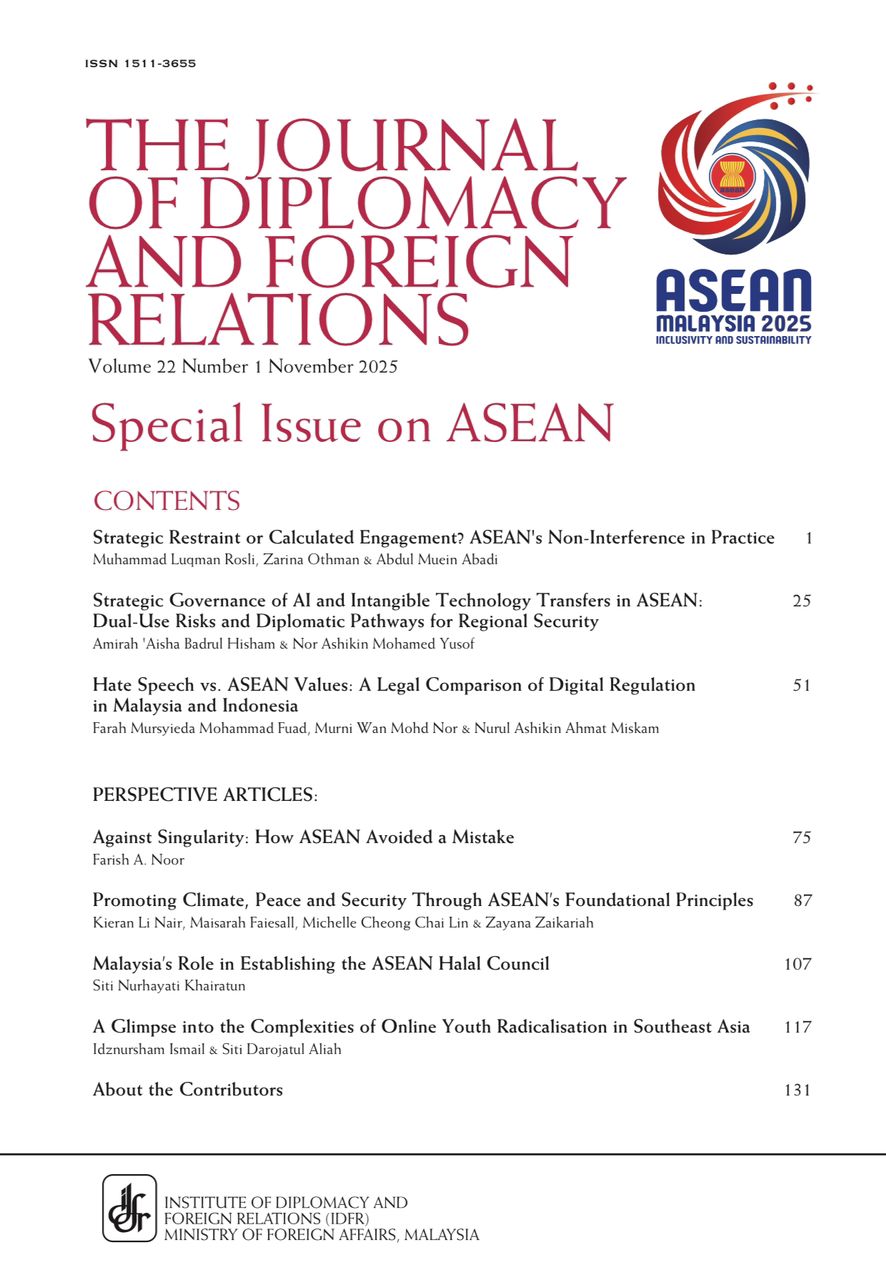
THE JOURNAL OF DIPLOMACY AND FOREIGN RELATIONS - VOLUME 22 Number 1 November 2025
Dato’ Zainol Rahim Zainuddin
Maslina Ngah Mamud
Dr Murni Wan Mohd Nor
Dr Muhammad Faiz Ramli
Ahmad Khairul Ridhwan Mohamed Hanif
Ahmad Muziru Idham Adnan
Nurul Farhah Ab Aziz
Munirah Mahmud
Contents
Strategic Restraint or Calculated Engagement? ASEAN’s Non-Interference in Practice
Download File Total Downloads 9894 time(s)
This article investigates the resilience, limitations, and evolving interpretations of ASEAN’s foundational principle of non-interference, a central tenet of the “ASEAN Way”. Conceived as a mechanism to uphold state sovereignty, regional harmony, and mutual respect, the policy of non-intervention has historically shielded ASEAN from direct involvement in the internal affairs of its Member States. However, contemporary security challenges, including transnational crises, humanitarian emergencies, and democratic regressions, have increasingly highlighted the tension between strict adherence to non-interference and practical demands of regional governance. Drawing on the case of Myanmar, this study traces ASEAN’s attempts to balance principle and pragmatism through mechanisms such as constructive engagement, flexible engagement, and enhanced interaction. This paper contends that although the principle of non-interference remains politically inviolable, its implementation has become selectively adaptive, indicating an informal transformation of ASEAN’s diplomatic norms. These developments highlight the need for a calibrated and codified framework that respects regional sensitivities while enabling ASEAN to respond more decisively when internal crises produce external repercussions.
Strategic Governance of AI and Intangible Technology Transfers in ASEAN: Dual-Use Risks and Diplomatic Pathways for Regional Security
Download File Total Downloads 1368 time(s)
This article examines the governance challenges arising from the dual-use nature of artificial intelligence (AI) in the ASEAN region, with a focus on intangible technology transfers under export control. AI is not a fixed, physical commodity. It comprises adaptable algorithms and computational models that operate within data-driven and distributed infrastructures. These systems depend on data inputs, computational infrastructure, and iterative training processes, making them inherently intangible, modular, and distributable across jurisdictions. This nature limits the applicability of conventional export control mechanisms, which were designed for physical commodities and well-defined hardware. Moreover, AI development channels are more diverse than often assumed. While open-source repositories, cloud infrastructures, and transnational collaborations are prominent, many systems are created in proprietary, on-premises, and siloed environments, often within secure corporate or government networks. Acknowledging this diversity is essential for policymakers to design proportionate and effective governance. The analysis draws on Malaysia’s Strategic Trade Act 2010 as a principal case study, situating it within broader policy developments. Findings reveal persistent legal and institutional gaps, as ASEAN’s fragmented regulatory landscape limits its capacity to manage dual-use risks. The study proposes strategic actions to harmonise legal standards, strengthen institutional capacities, and enhance ASEAN’s role in global AI governance.
Hate Speech vs. ASEAN Values: A Legal Comparison of Digital Regulation in Malaysia and Indonesia
Download File Total Downloads 1667 time(s)
Hate speech poses a growing threat to ASEAN’s multicultural and multireligious societies, particularly with the ubiquitous use of social media. While governments in the region have enacted cyber laws to address hate speech, these efforts often trigger concerns regarding the right to one’s freedom of expression (FOE). Through a comparative analysis of key statutes, this paper highlights recent regulatory responses to harmful online content, specifically hate speech, in selected ASEAN Member States — namely Malaysia and Indonesia. It examines Malaysia’s Communications and Multimedia Act 1998 and Online Safety Act 2025, as well as Indonesia’s Electronic Information and Transactions Law 2008 and the new Criminal Code (Law No. 1 of 2023) to compare policy implications, including similarities and differences in legal approaches. By assessing these latest legal developments, this paper explores how both countries balance between safeguarding societal harmony and upholding the right to FOE. Ultimately, this paper underscores the necessity of regulating online hate speech, aligning with principles consistent with ASEAN values pertaining to FOE.
Promoting Climate, Peace and Security Through ASEAN’s Foundational Principles
Download File Total Downloads 580 time(s)
Climate change poses a multidimensional threat to Southeast Asia, impacting political stability, economic resilience, and social cohesion across the ASEAN region. However, ASEAN currently lacks a holistic framework to address these issues in a coordinated manner. To fill this gap, this article examines how ASEAN can strategically integrate Climate, Peace and Security (CPS) into its foundational principles and institutional frameworks. Drawing on regional case studies and policy analyses, the article highlights how climate-induced stressors function as threat multipliers that exacerbate existing vulnerabilities and undermine traditional peacebuilding efforts. The article further assesses ASEAN’s existing mechanisms, including disaster response systems and environmental treaties, and identifies structural gaps in linking climate risks to security agendas. The article argues that ASEAN’s principle of centrality, consensus-based diplomacy, and cross-sectoral architecture offer unique opportunities to mainstream CPS without compromising sovereignty. Recommendations include leveraging ASEAN’s convening power to shape global CPS discourse; embedding CPS as a cross-cutting agenda within the ASEAN Political-Security and Socio-Cultural Communities; and enhancing regional preparedness through inclusive governance and institutional coordination. Ultimately, the article calls for a people-centric approach that positions ASEAN as a proactive leader in CPS governance, capable of navigating complex security risks while safeguarding regional peace and stability.
Malaysia’s Role in Establishing the ASEAN Halal Council
Download File Total Downloads 1408 time(s)
The halal industry has become a vital economic sector within the Association of Southeast Asian Nations (ASEAN), driven by the region’s large Muslim population, rising consumer awareness, and increasing government support. ASEAN is home to over 250 million Muslims, representing approximately 42 per cent of its total population, making it one of the largest Muslim-majority regions globally. The halal market extends beyond religious compliance, evolving into a global lifestyle trend embraced by both Muslim and non-Muslim consumers due to its association with ethical sourcing, cleanliness, and quality assurance. Malaysia, Indonesia, Brunei, Thailand, and the Philippines have emerged as key players in halal certification, production, and export. The ASEAN halal market was valued at USD 561 billion in 2023 and is projected to reach USD 608 billion by 2024, exhibiting a compound annual growth rate (CAGR) of 8.5 per cent. Malaysia plays a leading role in shaping the regional halal landscape through its comprehensive halal certification system and proactive policy frameworks. The country has proposed the establishment of an ASEAN Halal Council (AHC) to institutionalise regional cooperation, harmonise halal standards, and facilitate mutual recognition agreements (MRAs) among Member States. However, challenges such as divergent national legal frameworks, sovereignty concerns, and technical disparities in certification processes hinder progress toward full harmonisation. Strategic recommendations include gradual standardisation, capacity-building initiatives, digital integration for supply chain transparency, and the adoption of a tiered framework that accommodates both strict halal compliance and “Muslim-friendly” branding. If successfully implemented, the AHC could significantly reduce trade barriers, enhance market access, and position ASEAN as a unified leader in the global halal economy.
A Glimpse into the Complexities of Online Youth Radicalisation in Southeast Asia
Download File Total Downloads 2400 time(s)
Youths continue to be at risk of radicalisation, particularly with the ease of access to online information. Unfortunately, Southeast Asia is not immune to this global phenomenon. This is evident in various cases across the region. While ASEAN and its Member States strive to curb youth radicalisation, this article aims to augment these efforts by presenting factors that contribute to youths being radicalised online. This article does so by presenting a case study of nine Indonesian youths who were charged with terrorism offences. Their responses from structured interviews were thematically analysed. The article describes how social media was used by youths to seek religious knowledge and how the youths sought acceptance from radical groups as they struggled to fit into their communities. The article also describes how several men viewed joining radical groups as a means to demonstrate their masculinity, while some women joined in an effort to find an identity and a sense of belonging. This entailed perceiving the conduct of violence as a way of demonstrating bravery and asserting their control. This article subsequently presents lessons for ASEAN Member States on the need for youth-specific terrorism legislations and targeted interventions.


