




Journal of Diplomacy and Foreign Relations
THE JOURNAL OF DIPLOMACY AND FOREIGN RELATIONS - VOLUME 15 NUMBER 1 AUGUST 2015
Dato’ Hussin Nayan
Ambassador Aminahtun Haji A. Karim
Noraini Awang Nong
Azmah Mahmud
182 time(s)
Contents
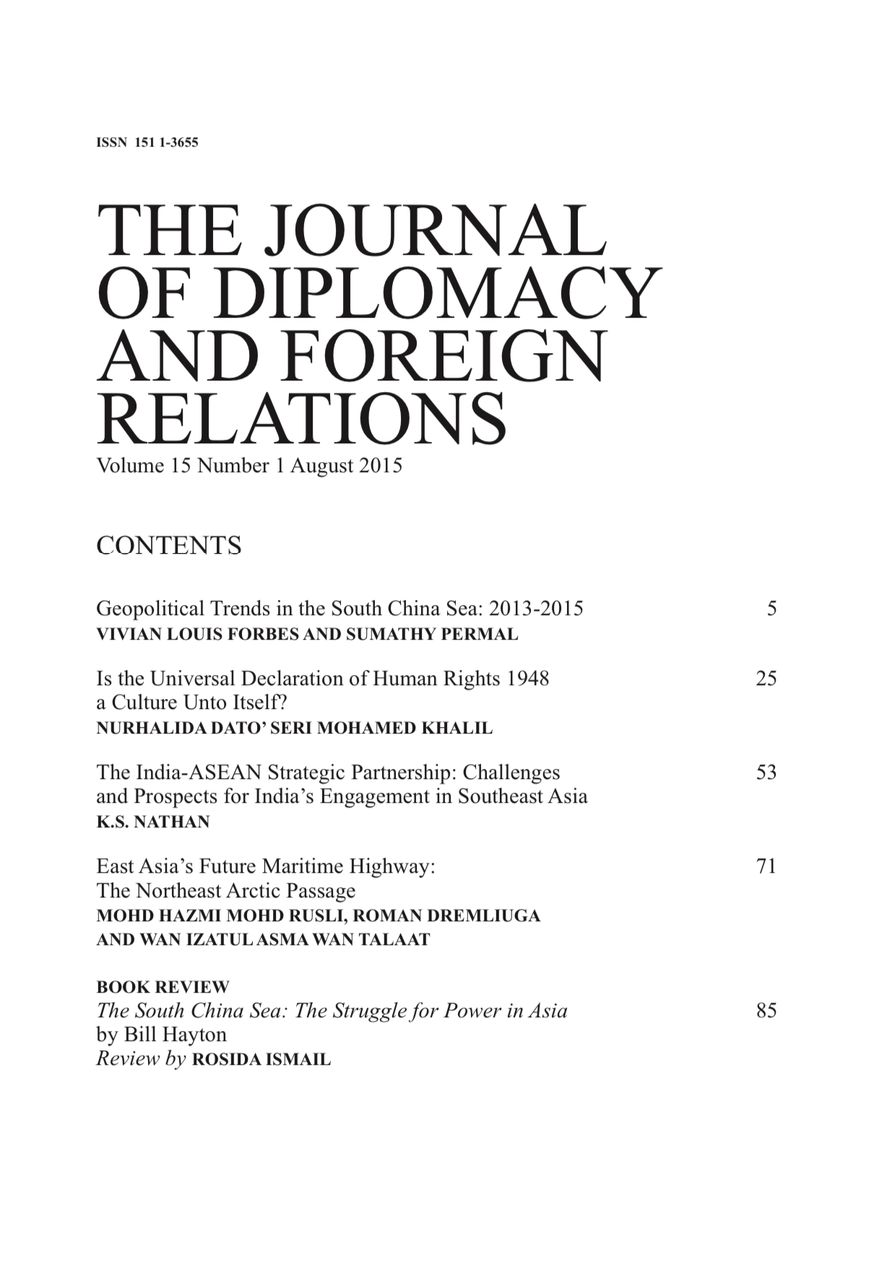
Geopolitical Trends in the South China Sea: 2013-2015
Download File Total Downloads 427 time(s)For researchers and scholars interested in international relations and maritime affairs, it is not an easy task to keep abreast of developments in the South China Sea. The concerning trends and tensions accumulating in the semienclosed basin attract much attention. Within the basin are hotly contested territorial and jurisdictional disputes loaded with historical baggage awaiting solutions diplomacy with a measure of customary international law. Within the South China Sea, six littoral States are seeking part or majority portion of maritime jurisdiction over the sea’s surface, in the airspace, on the seabed and its substratum and sovereignty over the marine features and resources within the basin. The major actor is the Government of China and its claim to a vast area of the basin which is vaguely defined but portrayed on a map which was first published in 1947. This study examines the developments in excess of two years commencing in January 2013 to mid-2015 and presents an analysis of events.
Is the Universal Declaration of Human Rights 1948 a Culture Unto Itself?
Download File Total Downloads 536 time(s)The article explores mainly the issue concerning cultures and evaluates their implications for universal human rights from various aspects including the inextricable linkage between culture and human duties and their ties to human rights, posing fundamental questions, the crux of which is: Is the Universal Declaration of Human Rights of 1948 a Culture Unto Itself? The article argues that much could be learned from a greater awareness of human diversity and human dignity. In a global community, the universal recognition of the fundamental principles of human rights and the universal acknowledgement of the diversity of cultures in different areas of human endeavours can serve as a copacetic basis for a constructive and ameliorating human rights dialogue.
The India-ASEAN Strategic Partnership: Challenges and Prospects for India’s Engagement in Southeast Asia
Download File Total Downloads 442 time(s)India and ASEAN as two major political entities are empowering themselves by discovering and developing synergies and points of convergence that are strengthening their bilateral interactions for the peace, security and development of Asia as a whole. In this evolving context of enhanced cooperation, they have elevated their relationship at the Commemorative Summit held in New Delhi in 2012 to the level of a Strategic Partnership. This new and higher level of engagement is a key factor in strengthening India’s engagement with ASEAN as a regional force, and in enhancing India’s strategic role in Southeast Asia. Thus, what is equally evident in this interactive process is the phenomenon of mutual empowerment. The emerging security dynamics in the second decade of the 21st century, marked principally by the rise of the two Asian giants – China and India – have obliged regional and global players to formulate new strategies and alignments to better defend as well as promote their interest in the region. Since 1991 when India started to actively Look East in the Post-Cold War era of Globalization, New Delhi identified ASEAN as a regional institution that could welcome and promote India’s proactive engagement with Southeast Asia. India’s growing political, military, economic and technological capacity also suggests the availability of 54 The Journal of Diplomacy and Foreign Relations greater resources for capacity building with ASEAN in terms of strengthening the region’s counter-terrorism and maritime capabilities. This article therefore focuses primarily on India-ASEAN political and security cooperation, and the challenges and prospects that lie ahead in translating the 2012 India-ASEAN Vision Statement creating a ‘strategic partnership’ into reality as the regional body itself progresses towards establishing the ASEAN Community by the end of 2015.
East Asia’s Future Maritime Highway: The Northeast Arctic Passage
Download File Total Downloads 972 time(s)Global warming is seen as a curse by some and as a blessing for others. The increasing world temperature has allowed for mariners to discover an alternative maritime passageway connecting Europe and the Far East other than the conventional Suez Canal-Straits of Malacca and Singapore maritime route i.e. the Northeast Arctic Passage (NAP). This article discusses the potentials for the NAP to be East Asia’s future maritime highway. Comparisons are made between the NAP and the Straits of Malacca and Singapore in terms of practicality of these routes for maritime navigation. This article concludes that so long as the Far Eastern economic powerhouses depend on the Middle East as the source of petroleum, the NAP will just become an alternative to the more popular Straits of Malacca and Singapore route for the shipping industry particularly in oil transportation.
The South China Sea: The Struggle for Power in Asia
Download File Total Downloads 457 time(s)Review by Rosida Ismail


